
Holly Harris, Elite Skater, On Her Mental Performance Strategies And Forging A Lasting Career In Sport
You can have a long career in sport with the right mindset and when you put the right people around you.
Holly Harris, elite skater and long-time client, recently returned to Australia for a brief visit. So I took the opportunity to have a conversation with her about travelling the world, training and competing in her sport.
Holly, a champion skater in multiple disciplines, has encountered various obstacles along her path, but what stands out is her ability to not only overcome those challenges but also leverage them as valuable skillsets to propel her career forward.
In our discussion, we delve into Holly's insightful experiences and discuss the strategies she has employed to navigate injury and setbacks, ultimately transforming them into unique skillsets that have enhanced her professional trajectory.
Join us as we share valuable tips that can potentially aid you in your own sporting career.
The Beginning: Resistance and Hair Clips
Holly's initial reaction to working with me was, well, let's just say there was some resistance. "I was like, 'Who's this guy going to watch me skate? Why do I need to work with a sports psychologist?'" she recalls with a laugh now. Like many young athletes, she didn't understand what mental performance coaching could offer – and to be fair, why would she at that age?
In those early days, Holly struggled with obsessive-compulsive behaviours that were significantly impacting her training. She required specific hair clips to skate, certain protective pads when jumping, and rigid warm-up routines. "I remember being stressed if we forgot the hair clips for my hair, which obviously has nothing to do with my skating," Holly reflects.
Thinking back, I was reminded that we actually cancelled a training session once because the hair clips weren't available.
Building Foundations: Glitter Pens and Goal Setting
The early sessions looked nothing like what we do today. We'd sit together, surrounded by lots of pink and glitter pens to stay engaged in the mental work. Working with a younger athlete is all about stimulating them and keeping them interested. For Holly, it was definitely the stationary.
Through these colourful sessions, we built fundamental skills: goal-setting frameworks, process funnels, and most importantly, the realisation that "I'm in control and not the hair clips." It was about helping her understand that she had the power, not these external objects.
The Journey: Challenges and Transformation
Holly's path wasn't linear... but whose is? She moved to the United States to train, living away from family at a young age. The sacrifices were immense, as they are for any elite athlete pursuing their dream at that level.
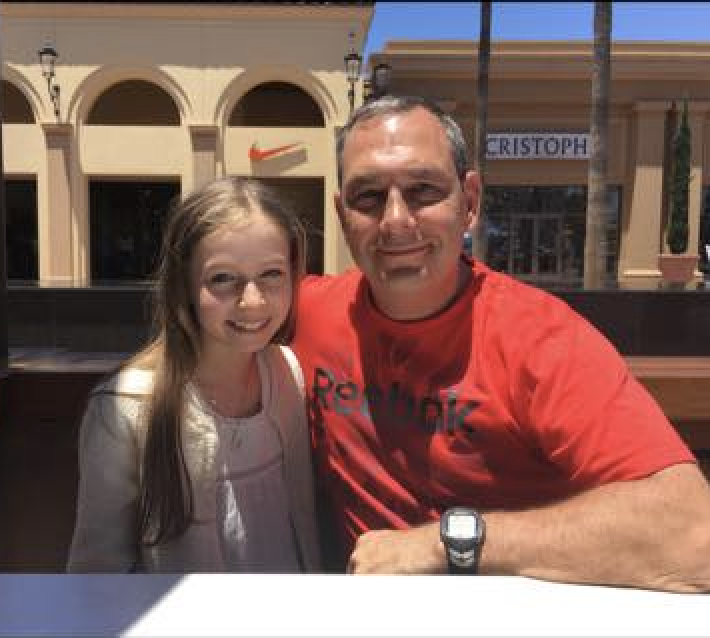
Huntington Beach, California, USA 2016
Then came the concussions. Three in total, with the recovery periods bringing their own particular darkness – no social media, no electronics, extended isolation from the very sport she loved.
"It was a depressing time. You can't train, you can't do anything," Holly remembers.
But here's what I've always admired about Holly: she found a way through. The first concussion became a turning point. After considerable deliberation, she switched from single skating to ice dance, discovering a discipline that aligned beautifully with her strengths in artistry, choreography, and performance.
Through it all, visualisation and injury management techniques became lifelines. As Holly learnt, "Just because I'm off the ice, it doesn't mean I can't physically train. I use visualisation and there's always something you can do to help get better."
That mindset – always finding what you can control – is what separates good athletes from great ones.
Evolution: From Resistance to Ownership
Over the years, the coaching relationship evolved. What began with resistance transformed into active ownership.
"I started to realise that I wanted to do this for myself, really, and not doing it for anybody else," Holly explains.
Living independently at a young age accelerated her willingness to take control of every aspect of her career. The work became more sophisticated – no longer about glitter pens, but about detailed, specific mental strategies. Our conversations changed. The sessions became very different. Holly now maintains rigorous daily practices:
- Visualising both routines twice daily
- Ball-bouncing techniques during warm-ups combined with visualisation
- Detailed goal-setting and debriefing sessions with her ice dance partner
- Journaling to manage self-talk and reinforce positive patterns
- Structured competition preparation following her "drop, set, go" strategy
"I have a system that when I go to competition, everything is the same. I know exactly what to do. It's like autopilot mode," she describes. That's exactly what we've been working towards – a system so ingrained that she doesn't have to think about it.
Finding Balance: The Recent Breakthrough
One of the most significant developments I've observed in recent years has been Holly's discovery of balance. For someone with such high expectations and relentless drive, this wasn't intuitive.
"I forgot in the last two years how I am a social person. I like to be social," Holly admits. "I think when I compete, I shut that aspect off of me and I just think, 'Okay, I just need to focus.' But it's not necessarily true because that's who I am."
This realisation – that she could socialise, enjoy time with friends, and still maintain her competitive edge – transformed her most recent season. "I enjoyed the season so much more and I made so many friends... If I'm just switched on all the time, I'm going to burn out and I'm going to get tired."
Watching this evolution has been brilliant. She's learnt that balance isn't a weakness; it's actually essential for peak performance.
Key Lessons: What Stands the Test of Time
When I asked Holly about the most valuable skill she's gained over our ten years together, she pointed to "banked knowledge" – the accumulation of successes, learnt processes, and proven strategies she can draw upon during challenging moments.
"If I do have a bad session or I'm having a day where I'm not sure about my process, I think back on my banked knowledge and everything that we've worked on, my list of successes, to build me up and remember what we've been working on."
She's also internalised the crucial lesson that "one bad session doesn't define you." This wisdom she now shares with other athletes. That's when you know the work has truly embedded – when they start coaching others.
Another core principle Holly's embraced: focusing on process over outcome. She said, "Don't focus on the score. That's just an outcome. It's out of your control. The judges are going to give you the score. You can just go and do your best and try and grow from the last competition."
Reflections on the Partnership
Our partnership represents how mental performance coaching needs to evolve with an athlete – from managing childhood behaviours to supporting elite-level competition preparation. The transformation has been remarkable. From a 10-year-old who needed specific hair clips to skate, to an Olympic athlete who trusts her process completely and can "just go full force" with self-belief.
I've learnt as much from Holly as she has from me. Every athlete I work with teaches me something new. And one of the most important lessons? You can't gauge your value just from one moment. If a strategy doesn't work the way we want it to in the moment, that's not a reflection of who we are. It just means we need to adapt, change, and go again. That applies to athletes and coaches alike.
Looking Ahead
As Holly prepares to compete at a future Winter Olympics, she carries with her a decade of mental training, countless visualisations, and the fundamental understanding that "work beats talent, always."
Her advice to her younger self?
"Trust the process, trust the journey. I went through a lot of ups and downs, and at times it's hard to imagine how it's going to work out. But it does. And if you want something, you can make it work."
For me, watching Holly's journey from those early sessions to the Olympic stage represents what's possible when an athlete commits to the mental side of performance. It's a reminder that success isn't just about physical talent or technical skill – it's about developing the mental resilience, self-awareness, and process-driven approach that enables athletes to perform when it matters most.
Now when Holly takes to the ice, she has a decade of mental preparation, unwavering self-belief, and the knowledge that she's done everything in her power to be ready for the moment.
I'll continue to watch her career with pride, as I always do. Not because I had a hand in her journey, but because of who she's become – both as an athlete and as a person. The tenacity, the resilience, the willingness to trust the process even when it's difficult – that's all her.
That’s high performance.
